
Summary
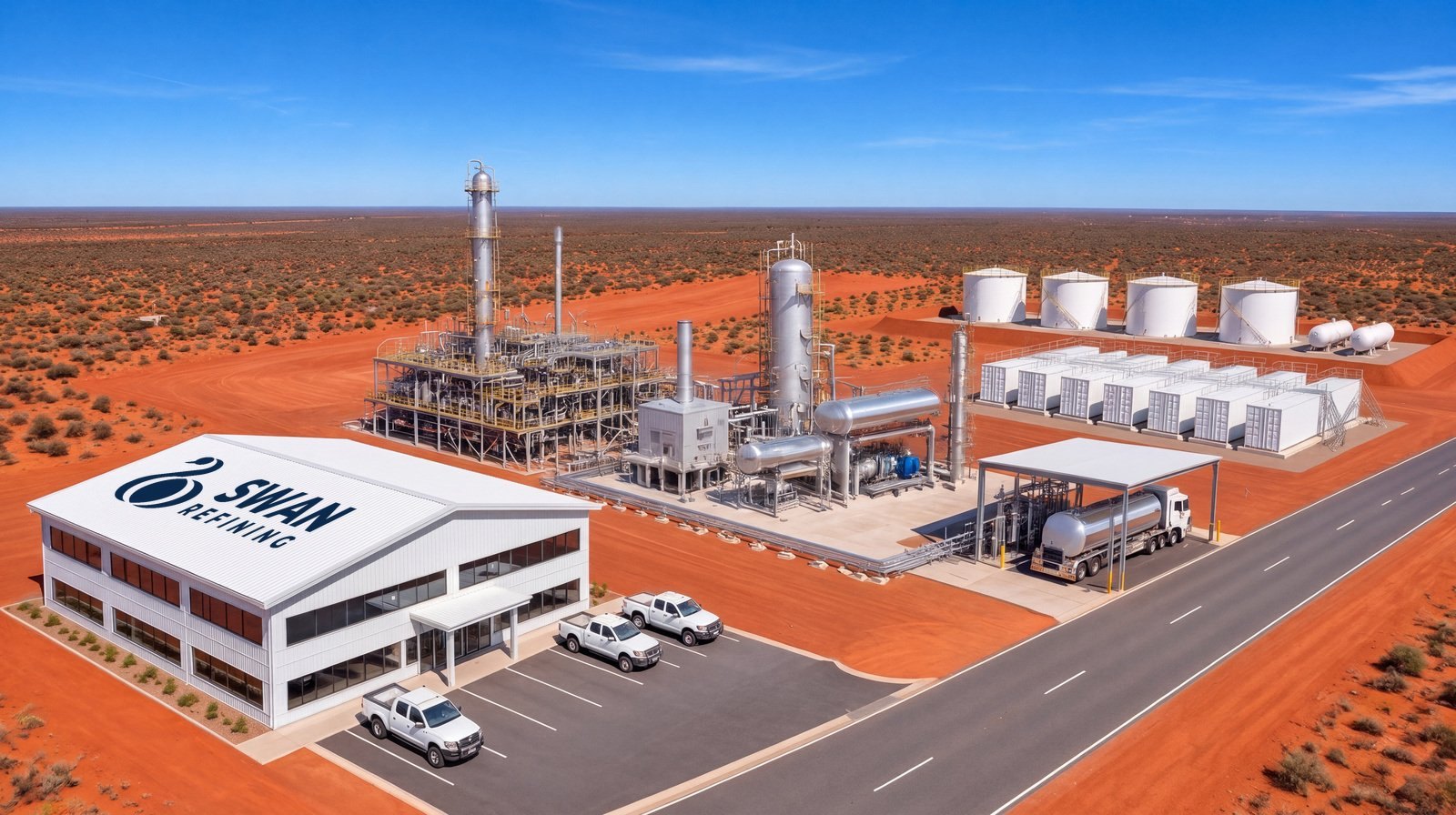
Swan Refining is developing a modular merchant refinery in Western Australia’s Northern Perth Basin. It will buy Condensate, and later Crude, from the basin’s producers and sell refined products into the State. This overview sets out why the opportunity exists, how the refinery will be built, and how producers and buyers can take part.
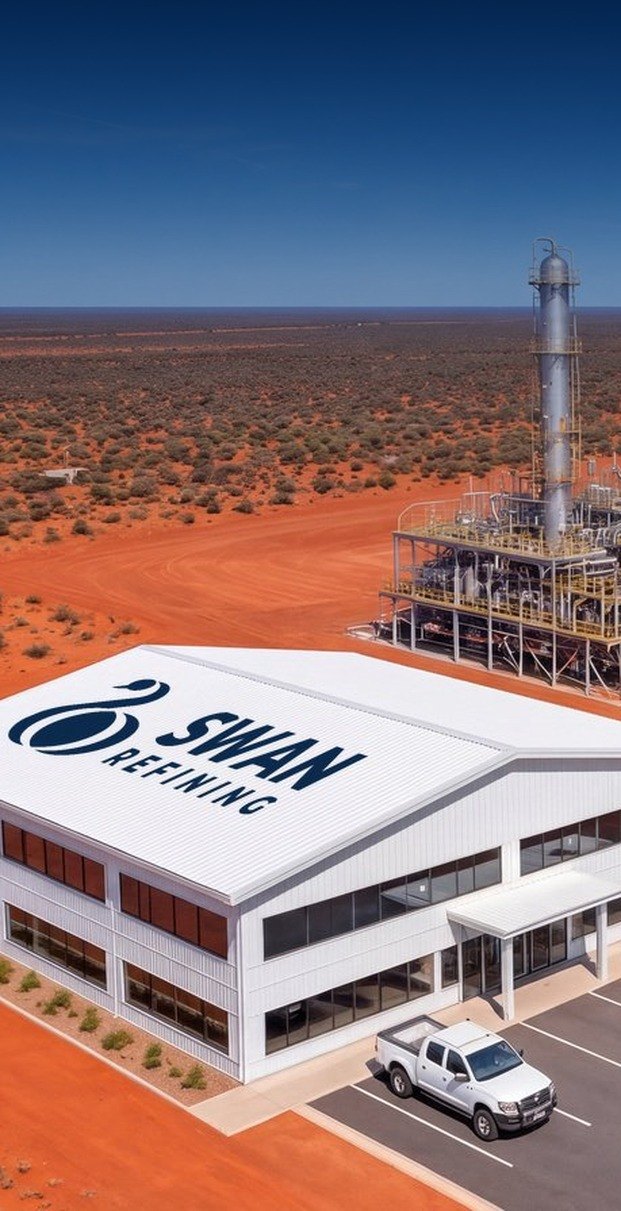
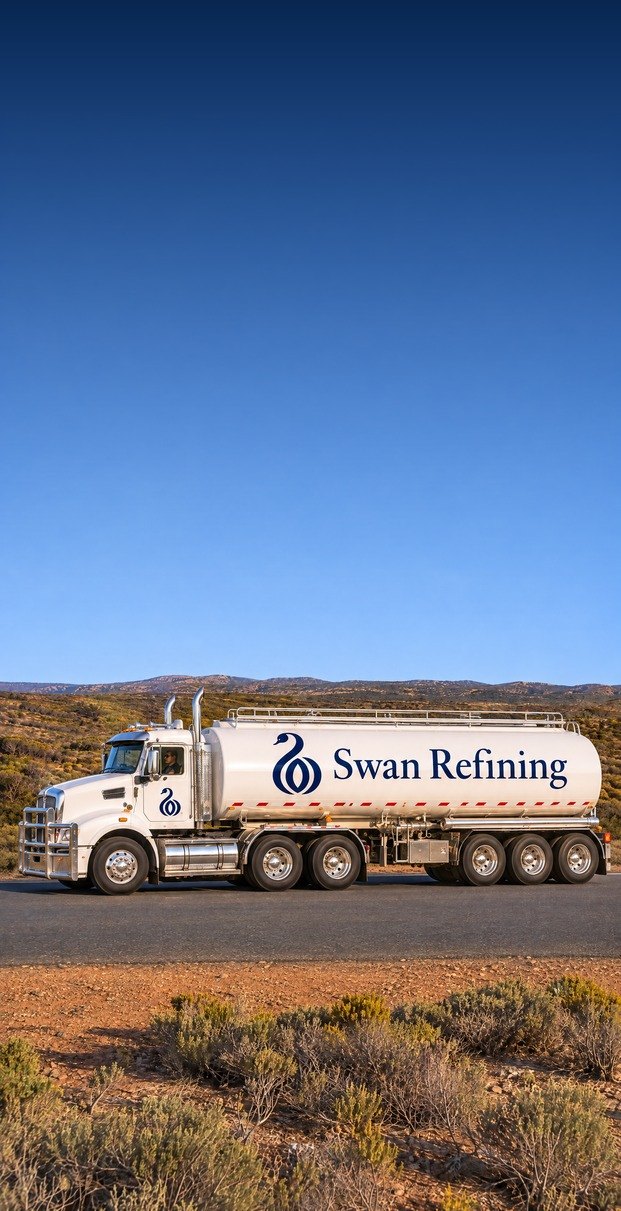
Images are illustrative.
- A State without a refinery. Western Australia has had no operating refinery since BP ceased refining at Kwinana in March 2021. The State sold 9,910.9 megalitres of petrol and diesel in the year to June 2026, supplied through marine terminals.
- Basin liquids travel 2,500 kilometres to be processed. Walyering Condensate has been trucked approximately 2,500 kilometres to Port Bonython in South Australia. A refinery in the basin will turn that journey into a regional haul.
- The established outlet is changing. Santos has approved a project to centralise processing at Moomba and close the Port Bonython fractionation plant.
- A plant sized to its counterparties. The first module is designed for 500 barrels a day, expandable in 500 barrel steps towards 2,000. Its scale will be set by the supply producers can offer and the products buyers want, not by market share.
- Feedstock tested in the laboratory. Laboratory assays of three Condensate streams and two Crude sources set the processing basis. Naphtha and kerosene make up about three quarters of both fully assayed Condensates.
- Distillates carry the premium. In the week to 30 October 2026 the Singapore diesel benchmark stood 45.7 cents a litre above Dated Brent, against 14.7 cents for petrol. Diesel is 83 per cent of State petrol and diesel sales.
- A second phase for Perth Basin Crude. Phase Two will add vacuum distillation, distillate hydrotreating and additional hydrogen generation, giving Perth Basin Crude its first local refining outlet since 2021.
- How producers and buyers take part. Swan invites producers and buyers to enter non-binding memoranda of understanding: 90 days of discussions with no price, volume or exclusivity commitment. The target for first product is late 2028.
Contents
- Introduction
- 1Local refining will keep more of the basin’s value in the region
- 2Western Australia sells almost ten billion litres of petrol and diesel a year
- 3Producers need a dependable outlet closer to the field
- 4The first module is designed around a 480 barrels a day blend from four basin streams
- 5A modular refinery configured to its feedstock and customers
- 6Products will be shaped by the feedstock and by what buyers need
- 7A shorter supply chain will create the commercial space
- 8Distillates carry the premium
- 9Phase Two will extend the platform to Perth Basin Crude
- 10Producers and buyers can shape the first module
- 11The path to a first module
- Schedule A. Condensate characteristics and measured yields
- Schedule B. Gas oil quality and the Phase One product basis
- Schedule C. Aviation fuel and Jingemia Crude
- Schedule D. Crude yields and laboratory references
- Source schedule
- Important notice
Introduction
Swan Refining Pty Ltd (Swan) proposes to build a merchant refinery that connects Northern Perth Basin Condensate and Crude with Western Australia’s market for petroleum products. Swan will buy feedstock at the gate and sell refined and intermediate products. Swan will refine purchased liquids; exploration and drilling form no part of the project.
The opportunity arises from a regional imbalance. Liquids produced in the basin leave it to be processed, while the State relies on fuel delivered through marine terminals. Processing a share of those liquids close to where they are produced will create value for producers, for wholesale buyers and for Swan.
The design basis is a first module of 500 barrels a day processing Condensate, expandable in 500 barrels a day increments towards 2,000. A second phase will add the processing needed for Perth Basin Crude. At this scale the refinery will be built around particular producers and particular customers.
For a producer, Swan will offer a local outlet that will improve the economics and reliability of liquids disposal. For a wholesale buyer, it will offer product made in Western Australia, delivered over shorter routes, from an additional source of supply. The commercial case rests on those relationships.
Swan has done the groundwork. It has reviewed regional supply and demand, holds laboratory evidence on Condensate and Crude, and has a modular development concept, a set of candidate sites and frameworks for supply and product discussions. The next step will shape the first module around the supply producers can offer and the products buyers will take.
This overview is written for prospective feedstock suppliers and product buyers. It presents the concept and its commercial rationale ahead of non-binding memoranda of understanding, and those discussions will shape the first module’s configuration, siting and commercial structure before detailed engineering and financing. It is not an investment memorandum and does not seek capital. Technical schedules and source references follow the commercial sections.
1. Local refining will keep more of the basin’s value in the region
Swan’s central proposition is to shorten the distance between production, processing and consumption, with a refinery matched to its suppliers and customers.
Western Australia has had no operating refinery since BP ceased refining at Kwinana in March 2021. Petrol and diesel reach the State through marine terminals and are distributed inland by road. In the Northern Perth Basin, Condensate is produced alongside natural gas and needs an outlet of its own, independent of the gas sales arrangements. The Walyering route runs approximately 2,500 kilometres by road to Port Bonython in South Australia, where the liquids are further processed and sold on as intermediate products.
A refinery in the region will replace part of that chain with a local purchase and delivery. On the product side, it will give buyers an alternative to supply that arrives through marine chains. The advantages will be lower transport exposure, less product in transit and a closer link between production and delivery.
1.1 The business will be sized around its customers
The first module will be small relative to Western Australian fuel consumption. At continuous nameplate operation, 500 barrels a day is 29.0 million litres of feed a year, equivalent to 0.29 per cent of the State’s reported petrol and diesel sales in 2025-26. Swan’s proposition is focused regional supply within an established market.
Swan will compete for feedstock on field netback: the producer’s return after transport, handling, quality adjustments and commercial terms. It will compete for buyers on the delivered value of an accepted product, including quality assurance, reliability and credit terms. These are the measures on which Swan’s relationships will be built.
Northern Perth Basin Condensate has no local refinery. Its route out of the basin is a long road haul to South Australia.
A refinery in the basin will shorten the producer’s haul and make fuel in the State where it is sold.
Proposed to follow Phase One. Added modules will let the refinery take a second class of feedstock.
Sources: Walyering disclosures (P3); Belisama planning approval (P4); Australian Petroleum Statistics (M1); Swan management (D2).
1.2 The basin offers room to grow
The modular design will let the refinery expand as supply and demand develop. The approved Belisama processing project points to a substantial future Condensate stream, and the Crude phase will broaden the feedstock base and add heavier distillates. Both will extend the business beyond the first module as the underlying fields are developed and supply is agreed.
Phase One will rest on the supply that supports a first module. Larger future streams and Crude processing are development options built on it, not inputs the first module depends on.
2. Western Australia sells almost ten billion litres of petrol and diesel a year
Reported sales of automotive gasoline and diesel oil in Western Australia totalled 9,910.9 megalitres in the year to June 2026, up 0.9 per cent on 9,820.0 megalitres in 2024-25. Diesel accounted for approximately 83 per cent of the total and grew, while petrol sales declined. That mix gives particular weight to the distillate products the refinery will make, alongside the petrol in the Condensate barrel.
Source: Australian Petroleum Statistics, August 2026 data vintage (M1). Sums of monthly State sales. Diesel includes automotive, biodiesel blends, industrial and marine grades. Western Australian aviation turbine fuel sales are suppressed for confidentiality and no jet fuel volume is assumed.
The size of the diesel market is why distillate treatment is the central configuration decision (Section 6). In Phase One, gas oil will be directed to non-automotive and blendstock markets.
| SCALE COMPARISON | FIRST MODULE | EXPANDED REFINERY |
|---|---|---|
| Nameplate feed throughput | 500 bbl/d | 2,000 bbl/d |
| Annual feed throughput at 365 days | 182,500 bbl | 730,000 bbl |
| Equivalent annual feed volume | 29.0 ML | 116.1 ML |
| Feed relative to State petrol and diesel sales | 0.29% | 1.17% |
Calculated at 158.987 litres a barrel. Feed throughput compared with market sales; not a production forecast, a utilisation assumption or a finished-product market share.
A local source will add diversity to the State’s supply. Nationally, imported refined products met 80.8 per cent of consumption on an energy basis in 2024-25 (M2). Refined products also move between states, so this is a national measure. Swan will add a regional supply option within that system.
Geraldton is an established part of the supply system. Its Berth 5 discharge system was upgraded in May 2025 and Berth 6 modifications are scheduled for completion in late 2026 (M5). That port and terminal infrastructure sets the competitive setting in which local products will be sold.
3. Producers need a dependable outlet closer to the field
Northern Perth Basin Condensate is a valuable liquid produced with natural gas. It needs dependable collection and a processing destination. Swan will provide that destination within the region, with purchase terms set against each producer’s alternative netback and operating requirements.
| STREAM | ROUTE | BASIS |
|---|---|---|
| Walyering | Road transport to Port Bonython, approximately 2,500 km | Transport arrangements and first deliveries disclosed in 2023; liftings reported in January 2025 (P3) |
| Waitsia and Beharra Springs | Port Bonython | Swan management (D2) |
| Lockyer Deep through Belisama | Regional road transport to Geraldton for export | Approved project includes Condensate stabilisation, storage and offloading, to be developed (P4) |
Sources: Walyering operator disclosures of June and October 2023 and later quarterly reporting (P3); Oil and Gas Journal, 17 May 2023, for the approximate distance; Swan management for Waitsia and Beharra Springs (D2); Belisama planning approval of 19 August 2026 (P4).
Port Bonython fractionates and stores liquids for onward sale; it does not make the finished transport fuels Swan will produce. The disclosed processing arrangement for Walyering accepted deliveries subject to available capacity, with no minimum or maximum delivery obligations, and its original term ended on 31 December 2023.
That outlet is also changing. Santos’s 2025 annual report records approval of the Cooper Midstream Simplification project to centralise processing at Moomba and close the Port Bonython fractionation plant. Work was reported as more than half complete at 30 September 2026 (P5). Santos has not published a cessation date or the arrangements for third-party trucked Condensate after the change, which leaves producers on that route weighing the durability of their disposal option.
Belisama is different. Its planned Geraldton route is a regional haul, so a local refinery will be measured against that export alternative rather than against Port Bonython. The planning approval provides for stabilisation of 288 to 377 cubic metres of Condensate a day, approximately 1,810 to 2,370 barrels a day, from mid-2029. That volume is relevant to Swan’s expansion; its timing follows the target for first product.
Each producer has its own transport, processing and sales arrangements. Swan’s offer will be built around them, combining reliable removal with a competitive netback.
4. The first module is designed around a 480 barrels a day blend from four basin streams
Swan’s design blend is approximately 480 barrels a day against a 500 barrels a day nameplate: 250 barrels a day from Walyering, 150 from Red Gully and 80 from Waitsia and Beharra Springs together. The blend is a design basis drawn from Swan’s assessment of basin production, not contracted volume.
The basin holds producing streams, shut-in capacity and fields at earlier stages of development. Separating these gives a sound basis for sizing the first module and planning its expansion.
| CONDENSATE SOURCE | POSITION | PRODUCTION OR POTENTIAL VOLUME |
|---|---|---|
| Walyering | Producing | 62 bbl/d reported for the September 2026 quarter (P1); up to 330 bbl/d historically, according to management |
| Red Gully | Shut in | 150 bbl/d at 5 TJ/d gas throughput when last producing; indicative range 100–200 bbl/d (management) |
| Waitsia | Producing | 60–100 bbl/d, with field life of 15 years or more (management) |
| Beharra Springs | Producing; wells with higher Condensate ratios restarting (management) | 20–30 bbl/d (management) |
| Ocean Hill | Exploration target | 300–500 bbl/d if successful (management) |
| Lockyer Deep through Belisama | Planning approval subject to conditions; pre-FID | Approximately 1,810–2,370 bbl/d from mid-2029 (P4) |
Walyering’s current rate is from Strike Energy’s quarterly report for the period ended 30 September 2026 (P1). The Belisama range is from its planning approval (P4). Other figures are Swan management estimates from the basin review of 9 April 2026 and later updates (D2). Producing, shut-in and prospective rates are not additive.
Strike Energy has installed field compression at Walyering to restore gas throughput (P3). The 250 barrels a day design contribution sits between the currently reported rate and the historical rate, and will be tested against production with compression in service. Red Gully’s 150 barrels a day matches its production before it was shut in and will enter the blend when the stream is brought back online.
Waitsia and Beharra Springs together carry a management estimate of 80 to 130 barrels a day, against 80 in the design blend. Producer discussions will settle the quantity, quality, timing and duration of supply from each candidate stream, together with the well selection and blending that will shape the supply profile over time.
5. A modular refinery configured to its feedstock and customers
Swan proposes a merchant refining business built on purchased Perth Basin liquids. The initial plant will combine atmospheric distillation with naphtha reforming to make petrol, alongside other saleable fractions. Working capacity will be 500 barrels a day, with additional modules providing a route towards 2,000 barrels a day as the commercial base expands.
The configuration will be matched to the agreed feedstock blend and the products customers accept. The laboratory record already identifies the main processing questions: the range of feed sulphur, the octane lift needed from the naphtha, and the treatment or marketing of gas oil. Detailed engineering will set unit specifications for the agreed commercial case.
Swan is assessing sites with access to the basin, road distribution and industrial infrastructure. Existing petroleum or industrial use can bring advantages, with services and approvals to be confirmed site by site.
| LOCATION | COMMERCIAL AND PHYSICAL RATIONALE | NEXT STEP |
|---|---|---|
| Red Gully | Existing gas facility in care and maintenance, with tankage, power and a pipeline connection | Refining extends beyond the existing approved use; planning and works approval pathway to be settled |
| Muchea, Shire of Chittering | Industrial park near the Great Northern Highway, approximately 50 km north-east of central Perth | Access to the Perth fuel market; site suitability and tenure under assessment |
| Narngulu, Greater Geraldton | Established industrial estate approximately 12 km south-east of Geraldton, with port, rail and airport access | Lots in the 2026 expression of interest were unserviced; DevelopmentWA is reviewing holdings against project requirements |
| Mingenew | Close to a potentially substantial future feedstock source | An expansion option rather than the basis for the first module |
The siting strategy will avoid carrying the fixed costs of two operating locations. If expansion favours a different site, the initial module would be relocated or retired, subject to engineering and economic assessment, and relocation will be considered as part of the initial scope.
The target for first product is late 2028, following feedstock arrangements, site selection, approvals, engineering and financing.
6. Products will be shaped by the feedstock and by what buyers need
Swan’s product strategy pairs the characteristics of basin liquids with the requirements of Western Australian buyers. Condensate carries a large naphtha fraction for petrol, together with kerosene, gas oil and light ends. Their proportions vary by stream, so the contracted blend will drive both the plant configuration and the value of its products.
| PRODUCT | ROUTE TO MARKET | BASIS |
|---|---|---|
| Unleaded petrol 91 | Phase One petrol grade, through naphtha reforming | Reforming to lift octane from 74.6–78.1 RON; blending to the full ULP91 specification |
| Kerosene | Standalone product or blend component | To be routed to customer specification and the selected feedstock |
| Gas oil | Non-automotive fuel or blendstock | Hydrotreating, if added, would open automotive diesel (Schedule B) |
| Liquefied petroleum gas | Light-end product | Recovery, specification and sale to be defined in the plant scope |
| Jet A-1 | An option where feed quality supports it | Full qualification and aviation quality assurance (Schedule C) |
Premium unleaded petrol 95 sits outside the Phase One proposition. The straight-run naphtha analysed has a research octane number of approximately 74.6 to 78.1. Reforming will lift its octane, and treatment and blending will be specified against the full ULP91 specification. Higher grades would need further octane enhancement or blendstock arrangements.
ASTM D2892 true boiling point distillation of whole Condensate. Red Gully cuts at 149, 232 and 334°C; ERL LD-1 at 140, 230 and 290°C. Yields are as reported and not normalised to common cut boundaries (Schedule A).
Phase One gas oil will be aimed at regional industry, mining and blendstock markets, reflecting the sulphur, density and cetane of the samples tested. Fuel oil for explosives manufacture is a prospective outlet, subject to buyer trials and an agreed acceptance specification.
Aviation fuel is a further option. The Red Gully kerosene assay is encouraging on the parameters tested (Schedule C), and Jet A-1 will follow full qualification. Where aviation fuel does not suit the feed, the kerosene fraction will be directed to other blends.
The size of the State’s diesel market and the benchmark price relationships in Sections 7 and 8 make distillate treatment the principal configuration decision. Swan will size that investment against the additional product value from the contracted blend, in step with buyer discussions, so that product requirements set the engineering scope.
7. A shorter supply chain will create the commercial space
Swan’s proposition combines a feedstock logistics advantage with access to a market supplied through long marine chains. Local processing will shorten the distance travelled by both the incoming barrel and the outgoing product.
On the feedstock side, the benchmark is the producer’s net return from its best alternative outlet. On the product side, it is the value a buyer pays for the specified grade at the agreed delivery point. Published prices frame both.
The residual between the Singapore benchmark and the tax-adjusted Perth terminal price was 24.5 cents a litre for petrol and 26.8 cents for diesel. It reflects quality differences, marine freight, insurance, losses, port and terminal costs, wholesale activity and timing, and it marks the commercial space in which a shorter regional chain will compete.
The feedstock transport saving will be established producer by producer. No freight rate is assumed in this overview.
8. Distillates carry the premium
In the week to 30 October 2026, the Singapore diesel benchmark stood 45.7 cents a litre above Dated Brent, against 14.7 cents for petrol. Against Tapis, the spreads were 37.2 and 6.2 cents a litre (M3). With diesel at 83 per cent of State petrol and diesel sales, a stronger distillate offering is worth more, weighed against the blend, attainable quality, buyer terms and the cost of treatment.
| AUSTRALIAN CENTS PER LITRE | PETROL | DIESEL |
|---|---|---|
| Singapore product benchmark | 123.8 | 154.8 |
| North Sea Dated Brent | 109.1 | 109.1 |
| Tapis Crude | 117.6 | 117.6 |
| Perth terminal gate price including tax | 222.2 | 258.8 |
| Terminal gate price excluding GST | 202.0 | 235.3 |
| Less fuel excise | 53.7 | 53.7 |
| Terminal gate price excluding GST and excise | 148.3 | 181.6 |
| Residual above Singapore product benchmark | 24.5 | 26.8 |
Source: Australian Institute of Petroleum weekly reports, week ending 1 November 2026 (M3). Singapore benchmarks are MOGAS95 and Gasoil 10ppm; international prices are weekly averages to 30 October and Perth terminal gate prices are the Friday postings. Excise at A$0.537 a litre, effective 3 August 2026 (M4); GST removed at one eleventh of the tax-inclusive price. Rounded to one decimal place. The residual is a market-price comparison, not a Swan cost or margin. AIP notes a lag of one to two weeks between benchmark movements and local prices; the diesel benchmark averaged 154.8 cents for the week, down from 158.3, and Perth diesel postings ranged from 256.3 to 259.6 cents. Swan targets ULP91, not MOGAS95.
Swan’s scale will let it choose its customers and products, competing on delivered value and reliability rather than seeking to replace established supply channels.
Governments are now examining domestic refining. In July 2026, the Commonwealth and Western Australian governments announced A$4 million for a pre-feasibility study into a proposed large-scale Western Australian refinery; the announcement set no capacity, feedstock or final site and committed no construction funding (M6). Swan is distinct in its smaller scale, its proximity to Northern Perth Basin liquids and its development around specific regional supply relationships.
Australia’s remaining refining capacity sits in two east-coast plants. Following an April 2026 incident at one of them, its operator indicated that it expected to run without the affected unit through 2027 (M7). That concentration makes supply diversity more valuable, while Swan’s case rests on regional feedstock and customer economics.
9. Phase Two will extend the platform to Perth Basin Crude
A Crude phase will broaden the refinery’s feedstock base and give Perth Basin producers a further local outlet. Kwinana previously took Crude from the basin under road-delivered supply agreements (D4); that route closed when refining ceased in 2021. Swan reports approaches from producers with undeveloped Crude seeking an alternative outlet.
Phase Two will add a vacuum distillation unit, a distillate hydrotreater and additional hydrogen generation to the Condensate plant. The aim is to recover and market a wider range of fractions and to treat the higher sulphur content of Crude-derived gas oil. Capacity and product routing will follow the Crude selected and the terms available from customers.
Jingemia provides the assay basis. The March 2003 sample is a light, sweet Crude at 37.8°API and 0.12 per cent sulphur by mass. It is waxy, with a 27°C pour point, and needs heated storage and handling or other measures to maintain flow. Its atmospheric gas oil is approximately one quarter of the barrel at 601 mg/kg sulphur, which is why distillate hydrotreating is part of Phase Two.
Jingemia: Intertek laboratory assay, March 2003. North Erregulla: laboratory assay of a well sample, 2024. Volume per cent of whole Crude. Light ends are the fraction to 19°C for Jingemia and LPG for North Erregulla; the vacuum gas oil upper cut is 525°C for Jingemia and 540°C for North Erregulla (Schedule D).
| CRUDE SOURCE | DEVELOPMENT POSITION | INDICATIVE PRODUCTION POTENTIAL |
|---|---|---|
| Jingemia | Shut in; restart and a proposed new well to assess attic oil and a deeper sand | 150–200 bbl/d from existing wells on restart; 500+ bbl/d with successful attic-oil drilling; 2,000+ bbl/d if the deeper sand is a discovery |
| North Erregulla | Development planning; cited 2C contingent resource of 31.6 million boe, including 30.9 million barrels of oil | 3,000–5,000 bbl/d |
Source: Swan management’s basin review of 9 April 2026 and later information (D2). Rates depend on the stated development outcomes and are neither offered nor contracted volumes. The resource classification is not a production commitment.
Vacuum distillation recovers heavier material from the atmospheric residue. Vacuum gas oil boils above the automotive diesel distillation limit and will be marketed as a heavier industrial gas oil, with residual material directed to bitumen feed at Kwinana, on management’s account and subject to buyer acceptance.
North Erregulla’s 2024 sample carries a larger heavy fraction, which raises the importance of vacuum distillation to its processing case (Schedule D). Phase Two will follow the establishment of Phase One, on its own confirmed supply, product and engineering basis.
10. Producers and buyers can shape the first module
Swan seeks counterparties whose requirements will help size and configure the first module. Early discussions will let producers and buyers assess a local refining relationship before the plant’s scope and contract structure are fixed.
10.1 Feedstock suppliers
For producers, the proposition is a competitive field netback and dependable removal of liquids. A nearby buyer will reduce haulage exposure and simplify the route to market. Terms will address the purchase formula, collection obligations, credit support and arrangements for periods when the refinery is unavailable.
Discussions will cover the volumes and quality available, their expected profile over time and the producer’s existing alternatives. Commercial terms will cover nomination, delivery windows and scheduling, independent inspection and assay at an agreed measurement point, quality adjustments, title and risk transfer, settlement and outage contingencies, with joint-venture approvals or co-owner consents where the production offered requires them.
Swan will be a competitive buyer of liquids that already carry economic value. For reference, Beach Energy reported a portfolio Condensate realisation of A$122 a barrel for the September 2026 quarter (P2); it is not a price for any individual Perth Basin stream. Swan’s terms will be assessed against each supplier’s actual netback and service requirements.
10.2 Product buyers
For buyers, Swan will offer a local source with a product slate and delivery arrangements built around their requirements. A shorter physical chain will support replenishment, inventory management and supply diversity. Discussions will cover product specifications, pricing, an annual quantity with monthly nominations, collection at the refinery gate or delivery to agreed bulk points, minimum lift sizes and lifting frequency, a certificate of analysis for each delivery, and continuity of supply.
A buyer may take one product or several, and no single supplier or buyer is expected to cover the whole refinery. This suits Phase One, where petrol, kerosene, gas oil and light products serve different markets. Any aviation fuel arrangement will carry its own qualification and release requirements.
10.3 How the discussions work
The proposed memorandum of understanding sets a fixed period for technical and commercial engagement without a supply or offtake commitment. The current framework provides 90 days of discussions, extendable by agreement, with confidentiality provisions lasting two years and indicative heads of terms identifying the matters to be explored (D6).
The discussions will be non-binding apart from specified provisions such as confidentiality. The framework sets no price or volume, requires no exclusivity and creates no obligation to conclude a definitive agreement or to procure satisfaction of its conditions. Either party may discontinue discussions under the memorandum, and the signed terms will govern the relationship.
For counterparties with a fit, the memorandum will let them assess the opportunity and influence the initial scope. Swan’s immediate objective is to establish the supply and product relationships on which the first module will be built.
11. The path to a first module
The current phase will define a commercially supported first module. Producer discussions will set the feedstock profile, and buyer engagement will set the product requirements and outlets. Engineering will then size the process units, treatment, utilities and site infrastructure against that combined basis.
Capital requirements will follow from the selected scope, supported by engineering and supplier quotations, and no capital estimate is presented here. A subsequent investment memorandum will address the financial model, use of funds, financing structure and the allocation of capital between process equipment, site works and establishment.
11.1 Site and engineering definition
Site evaluation will cover access to feedstock and customers, land use, tenure, services, storage, safety requirements and the cost of establishment and expansion. At Red Gully, the approvals pathway for refining, including whether development approval must precede an updated works approval, is being settled with the relevant authorities and advisers before a site is selected.
Engineering will confirm the reformer’s feed tolerances, particularly for sulphur, and any naphtha treatment the selected blend needs. Gas oil treatment is a separate commercial and engineering decision. The equipment brochure’s processing range of 15 to 55°API will be confirmed against the lighter feeds, including Red Gully at 55.4°API.
11.2 Approvals
The development will require planning, environmental, dangerous goods and fuel manufacturing permissions. The project records identify a Western Australian works approval and operating licence, an Australian Taxation Office excise manufacturer licence and an anticipated major hazard facility assessment and safety case, each to be confirmed for the selected site and final design (R2).
The December 2024 concept design anticipated major hazard facility classification. It concerned a different candidate site and serves as an initial basis rather than a classification for the eventual facility.
11.3 The invitation
Swan’s invitation is to producers and buyers who see potential in a regional refining relationship. Establishing the supply available and the products customers can use will take the project from concept to an engineering scope backed by counterparties.
Schedule A. Condensate characteristics and measured yields
Two streams have full atmospheric distillation assays, and the Walyering composite certificate gives whole-feed properties. Further Walyering sand and distillation analyses are held. The samples differ in date and composition and do not represent a contracted blend.
Walyering’s composite meets the 0.1 per cent sulphur sales specification on its certificate. That is a feedstock sales specification, not a finished-fuel standard. Its sulphur is higher than the 59 to 85 mg/kg reported for four samples labelled Sand A to Sand D in 2022-PTAD-000407. Management identifies both sets as Walyering material, and current sampling against the producer’s expected well and blending configuration will reconcile them.
| STREAM | LABORATORY REFERENCE AND DATE | GRAVITY OR DENSITY | WHOLE-FEED SULPHUR |
|---|---|---|---|
| Walyering composite | Intertek 2023-MDTN-000865 Rev 0; sampled 12 October 2023 | 791.1 kg/m³ at 15°C | 720 mg/kg by ASTM D5453 |
| Red Gully | Intertek 2014-FED-035455; reported 8 August 2014 | 55.4°API; 0.7566 kg/L | 55 mg/kg by ASTM D4294 |
| ERL LD-1 | AmSpec 501-22-02793 revision 1; reported 24 May 2022 | 44.8°API | 35 mg/kg by ASTM D5453 |
The additional Walyering report, Petrolab 2023-PTAD-000404, contains more extensive distillation and cut data but no total sulphur result. No laboratory analysis is identified in the project record for Waitsia or Beharra Springs. Current representative assays will set the engineering and purchase specifications.
| FRACTION | RED GULLY CUT | YIELD | ERL LD-1 CUT | YIELD |
|---|---|---|---|---|
| Light ends | LPG | 5.6% | LPG | 0.8% |
| Naphtha | C5–149°C | 58.3% | C5–140°C | 39.8% |
| Kerosene | 149–232°C | 20.2% | 140–230°C | 34.1% |
| Gas oil | 232–334°C | 12.4% | 230–290°C | 12.4% |
| Material above final cut | Above 334°C | 3.4% | Above 290°C | 12.9% |
ASTM D2892 true boiling point distillation. Percentages are of whole Condensate and are not normalised to common cut boundaries. Red Gully distillation stopped at 334°C under the method’s stoppage criteria; displayed yields may not total exactly 100 per cent because of rounding.
The ERL LD-1 material above 290°C includes material within a conventional gas oil boiling range. The project’s reading of its boiling curve indicates approximately 4 per cent above 370°C and a gas oil fraction of 21 to 22 per cent at a deeper cut. This reading is distinct from the laboratory’s reported 230 to 290°C yield; engineering will confirm it for the selected operating cut points.
Schedule B. Gas oil quality and the Phase One product basis
The assayed straight-run gas oil cuts identify the quality parameters that govern product selection. The comparison below uses the parameters and methods of the Australian conventional diesel determination cited in the project record (R1). It is a screening comparison, not certification of a finished product.
Sulphur concentrates in heavier fractions. Red Gully’s measured gas oil sulphur of 134 mg/kg exceeds its whole-feed result of 55 mg/kg, which shows why a low-sulphur feed does not on its own establish compliant diesel. Hydrotreating with a suitable hydrogen source will be used where needed to reach the target sulphur specification.
Under management’s Phase One concept, gas oil will be sold into non-automotive and blendstock markets, without hydrotreating. The December 2024 concept design includes naphtha reforming and a hydrogen generator, and the April 2026 supplier assessment does not include a hydrotreater. A second supplier offers hydrotreating equipment for consideration.
| PARAMETER | REFERENCED LIMIT | RED GULLY 232–334°C | ERL LD-1 230–290°C |
|---|---|---|---|
| Cetane index by ASTM D4737 Procedure A | Minimum 46 | 49.4 | 38.1 |
| Sulphur | Maximum 10 mg/kg | 134 mg/kg by D4294 | 13 mg/kg by D5453 |
| Density at 15°C | 820–850 kg/m³ | 851.1 kg/m³ | 866.1 kg/m³ |
| Polycyclic aromatics by IP 391 | Maximum 11.0% by mass | 11.3% | Not reported |
| Kinematic viscosity at 40°C | 2.0–4.5 mm²/s | Not reported | 2.492 mm²/s |
Source instrument: Fuel Quality Standards (Conventional Diesel) Determination 2025, F2025L00164, with the compilation and amendments identified in the source schedule (R1). The regulated sulphur method is ASTM D5453 and the density method ASTM D1298; reported assay methods will be reconciled in a full compliance assessment. Each assay has different cut boundaries.
Naphtha treatment is being assessed separately. Management interprets the ERL LD-1 assay as showing approximately 1.3 to 1.6 ppm sulphur in the naphtha. The reformer supplier has been asked to confirm catalyst tolerance, which will determine whether the selected blend needs pretreatment; a low finished-product sulphur result does not by itself establish suitability at the reformer inlet.
Cetane index depends on composition and cut selection, and density and aromatic content may call for changes to processing or blending. Each product route will be established on its own feasibility and economics, and the Phase One non-automotive gas oil proposition does not assume that compliance follows from distillation.
The source material also cites a maximum diesel T95 of 360°C and a minimum flash point of 60.5°C until 30 June 2027, rising to 61.5°C from 1 July 2027. The regulatory basis in force when the plant operates will govern product qualification. Total aromatics is not itself a compliance parameter under the cited determination.
Schedule C. Aviation fuel and Jingemia Crude
Kerosene and Jet A-1
Red Gully kerosene shows a smoke point of 22.5 mm, aromatics of 21.7 per cent by volume and naphthalenes of 0.72 per cent by volume, against the project’s cited screening limits of 19 mm minimum, 25 per cent maximum and 3 per cent maximum respectively. Thermal stability and existent gum were not tested. Walyering’s two kerosene sub-cuts fall short of the smoke point and aromatics screening described in the project records. Jet A-1 is conditional on full testing, specification compliance and an agreed aviation quality regime.
Jingemia Crude
The March 2003 Intertek assay records whole-Crude density of 0.8354 g/mL at 15°C, gravity of 37.8°API, sulphur of 0.12 per cent by mass, wax content of 12.6 per cent and a pour point of 27°C. It is a historical sample; management reports no later assay in the project record.
Management envisages recovering a further heavy gas oil fraction through vacuum distillation, with approximately half the Jingemia barrel falling within the combined atmospheric and heavier gas oil ranges. The heavier fraction’s boiling range extends beyond the cited automotive diesel limit, and its product routes will be assessed separately from road fuel.
| FRACTION OR PROPERTY | ASSAY RESULT | PROCESSING RELEVANCE |
|---|---|---|
| Naphtha, 19–70°C and 70–140°C | Sulphur below 10 mg/kg in each cut | Suitability to be confirmed against reformer inlet limits and the intended blend |
| Kerosene, 140–230°C | Sulphur 30 mg/kg; mercaptan sulphur 1 mg/kg; smoke point 28 mm; freezing point −58°C | Encouraging properties; complete product qualification required |
| Gas oil, 230–360°C | Sulphur 601 mg/kg | Distillate hydrotreating envisaged for automotive diesel |
| Gas oil, 250–360°C | Cetane index 58.0 by ASTM D976 | A different cut and method from the comparison in Schedule B |
| Atmospheric residue above 360°C | 26.3°API; sulphur 0.20%; pour point 45°C | Heated handling, vacuum processing and residual outlets |
Under management’s Crude concept, hydrogen demand will exceed the reformer’s expected output. An electrolytic hydrogen generator is envisaged alongside the hydrotreater, sized to the final duty. Heated storage and traced lines, or suitable pour-point treatment, will be considered for waxy Crude and residues. Management reports that warm-loaded Crude can be transported by road without problematic cooling; logistics and operating conditions will be confirmed in design.
Potential outlets for heavier products include industrial fuels and, for residual material, bitumen feed at Kwinana. Each will require an accepted specification and commercial arrangement.
Schedule D. Crude yields and laboratory references
The available Crude assays show materially different splits between light products and heavier fractions, which bears on the value of vacuum distillation and the products to be marketed in Phase Two.
| FRACTION | JINGEMIA 2003 | NORTH ERREGULLA 2024 |
|---|---|---|
| Light ends | 2.2% | 1.3% |
| Naphtha to 140°C excluding light ends | 15.5% | 4.2% |
| Kerosene, 140–230°C | 15.3% | 9.2% |
| Atmospheric gas oil, 230–360°C | 25.1% | 26.3% |
| Vacuum gas oil | 28.4% | 38.2% |
| Vacuum residue | 13.5% | 20.8% |
Volume percentages reproduced from the assay presentation in the project material. Jingemia light ends are the fraction to 19°C; North Erregulla light ends are LPG. The vacuum gas oil upper cut is 525°C for Jingemia and 540°C for North Erregulla. Each column totals 100 per cent. These yields do not establish final product grades.
Laboratory references
Walyering Condensate. Intertek certificate of analysis 2023-MDTN-000865 Rev 0; sample reference 2023-MDTN-000865-001. Composite drawn from a road trailer at Walyering Gas Plant on 12 October 2023, received 13 October and reported 14 October. Density 791.1 kg/m³ by ASTM D4052; sulphur 0.072 per cent by mass by ASTM D5453; Reid vapour pressure 62 kPa by ASTM D323; total acid number 0.02 mg KOH/g by ASTM D664. Mercury, arsenic and lead below detection. No distillation accompanies this certificate. Additional reports: 2022-PTAD-000407 and Petrolab 2023-PTAD-000404.
Red Gully Condensate. Intertek Singapore report 2014-FED-035455, reported 8 August 2014. Gas oil at 232–334°C: volume yield 12.4 per cent and mass yield 14.0 per cent; density 0.8511 kg/L; gravity 34.7°API; cetane index 47.0 by ASTM D976 and 49.4 by ASTM D4737 Procedure A; sulphur 0.0134 per cent by mass; cloud point −10°C and pour point −12°C. Total aromatics of 29.6 per cent by volume by ASTM D1319 carries an out-of-range precision qualification because the final boiling point exceeds 315°C. Polycyclic aromatics are 11.3 per cent by mass by IP 391.
ERL LD-1 Condensate. AmSpec report 501-22-02793 revision 1, reported 24 May 2022. Whole-feed nitrogen 7.1 mg/kg by ASTM D4629; total aromatics 21.6 per cent by volume by ASTM D1319, outside the method’s scope with precision undetermined. Gas oil at 230–290°C: volume yield 12.4 per cent and mass yield 13.4 per cent; density 0.8661 kg/L; gravity 31.8°API; cetane index 38.1 by ASTM D4737 Procedure A; total aromatics 36.5 per cent by volume; sulphur 13 mg/kg; viscosity 2.492 cSt at 40°C; cloud point −33°C. Polycyclic aromatics are not reported.
Jingemia Crude. Intertek Testing Services Petroleum Testing Laboratory, March 2003. Cumulative volume yields: 2.2 per cent to 19°C; 17.7 per cent to 140°C; 33.0 per cent to 230°C; 58.1 per cent to 360°C; and 86.5 per cent to 525°C. Sulphur measured by ASTM D5453.
North Erregulla Crude. Laboratory assay of a well sample, 2024, held by the project; principal yields are shown above.
Source schedule
Market and infrastructure
M1. Department of Climate Change, Energy, the Environment and Water, Australian Petroleum Statistics, August 2026 data vintage, worksheets “Sales by state and territory” and “Data sources and notes”. Basis for Western Australian sales and annual comparisons.
M2. Department of Climate Change, Energy, the Environment and Water, Australian Energy Statistics Update Report 2026, energy trade, published September 2026. Basis for the national import share measured on an energy basis.
M3. Australian Institute of Petroleum, Weekly Petrol Prices Report and Weekly Diesel Prices Report, week ending 1 November 2026, with international and wholesale data to 30 October 2026. Basis for the market-price comparisons. Australian Competition and Consumer Commission weekly fuel price monitoring report, 27 March 2026, is also cited in the project record for benchmark identification.
M4. Australian Taxation Office fuel schemes and excise duty rate schedules, rate stated in the project record as effective from 3 August 2026. The source material records the end of temporary excise relief on that date, so prices across that change require consistent tax adjustment.
M5. Mid West Ports Authority, Geraldton Port Maximisation Project update and Main Harbour schedule of tariffs 2026-27, retrieved 4 November 2026. Basis for the terminal developments. The published 2026-27 fuel pipeline tariff is A$0.25 per revenue tonne, excluding tax; it is one charge, not the total cost of using the port.
M6. Prime Minister of Australia media release, 28 July 2026, on joint funding for a Western Australian refinery pre-feasibility study. Karratha was the location of the announcement, not a confirmed project site.
M7. Refinery operator announcements of 16 April and 23 June 2026; joint Commonwealth media release of 16 April 2026. Basis for the refinery incident and the expected period without the affected unit.
Producers and regional projects
P1. Strike Energy, 1Q FY27 quarterly report for the period ended 30 September 2026, dated 29 October 2026. Walyering production and ownership; the project record identifies Strike as 100 per cent owner and operator of Walyering, L23 and EP447.
P2. Beach Energy, FY27 first-quarter activities report, dated 21 October 2026, for portfolio Condensate realisation; annual report 2024 for Waitsia and Beharra Springs interests. The cited ownership is Beach 50 per cent and Mitsui E&P Australia 50 per cent, with Mitsui operating Waitsia and Beach operating Beharra Springs.
P3. Talon Energy and Strike Energy Walyering disclosures of 19 June and 9 October 2023 and subsequent quarterly reporting, including January 2025 liftings and the quarterly report of 30 July 2026; Strike Energy announcement of 9 June 2026 on field compression. Oil and Gas Journal, 17 May 2023, for the approximate road distance to Port Bonython.
P4. Western Australian Planning Commission determination of 19 August 2026 for the Belisama central processing facility, Lot M441 Yandanooka West Road, Milo, approximately 25 kilometres south-west of Mingenew. Management identifies Lockyer Deep as the feed source.
P5. Santos annual report 2025 and progress reporting to 30 September 2026 on Cooper Midstream Simplification. The stated drivers include fuel cost savings and a reduction in scope 1 emissions of approximately 110,000 tonnes of carbon dioxide equivalent a year. Third-party Condensate arrangements following the change are not specified in the cited material.
Project records and regulatory references
D1. Australian Securities and Investments Commission certificate of registration for Swan Refining Pty Ltd, 8 September 2026. ACN 702 176 903; ABN 64 702 176 903; registered office 9 Bishop Street, Jolimont, Western Australia 6014.
D2. Swan basin feedstock review, 9 April 2026, and subsequent management information, including July 2026 updates. Basis for estimates not separately available in public disclosure. References to management in this overview mean Swan Refining Pty Ltd management.
D3. Laboratory reports identified in Schedules A to D, held by the project. Their dates, sample descriptions and analytical methods form part of the basis on which the results are presented.
D4. Supply agreements for Perth Basin Crude delivered by road to Kwinana, 2006 and 2016-17, held by the project. Basis for the historical local outlet.
D5. Concept design prepared in December 2024; supplier assessment of April 2026; equipment brochure; planning advice and site correspondence described in the project record. These materials inform the development concept and are not a final site-specific design or procurement commitment.
D6. Draft Condensate and Crude supply and wholesale product memoranda of understanding. Basis for the proposed discussion framework, subject to the terms agreed and signed by the parties.
R1. Fuel Quality Standards (Conventional Diesel) Determination 2025, Federal Register identifier F2025L00164; compilation F2026C01028, stated in the project record as in force from 1 October 2026; Amendment Determination (No. 2) 2026, F2026L01342. Referenced parameters include sulphur by ASTM D5453, cetane index by ASTM D4737 Procedure A, density by ASTM D1298, polycyclic aromatic hydrocarbons by IP 391, viscosity by ASTM D445, distillation by ASTM D86 and flash point by ASTM D93.
R2. Excise Act 1901, including section 25, and the ATO excise manufacturer licensing regime. Environmental Protection Act 1986 (WA), including sections 52 and 56; Environmental Protection Regulations 1987, Schedule 1 category 34, which the source material identifies as applying to refining or processing Crude oil, Condensate or gas without a production threshold. Major hazard facility and dangerous goods requirements will be confirmed for the selected facility and site.
R3. Corporations Act 2001 and Competition and Consumer Act 2010, Schedule 2, Australian Consumer Law, as referenced in the project material.
Terminology
Condensate is the light liquid hydrocarbon stream produced with natural gas. Naphtha is the light distillate used as feed for petrol production. Gas oil describes a distillate boiling range and does not by itself establish automotive diesel compliance. Netback is the producer’s realisation after the costs of reaching the sale point.
Reforming raises naphtha octane; hydrotreating uses hydrogen to remove sulphur and may affect other properties depending on process design. Vacuum distillation separates heavier material at reduced pressure. TBP means true boiling point; °API is a measure of petroleum liquid density; bbl is a barrel of 158.987 litres and bbl/d barrels a day; ML is one million litres; FID means final investment decision.
Important notice
This confidential overview presents Swan Refining Pty Ltd’s Perth Basin modular refinery concept for prospective feedstock suppliers and product buyers. It is provided for discussion and general information. It is not an investment memorandum, an offer or invitation to subscribe for or purchase securities, financial product advice or a recommendation to invest.
The project is at concept stage and remains subject to feasibility, commercial agreements, site and tenure, approvals, financing and final investment decision. At the date of this overview, feedstock and offtake are uncontracted, a site and tenure are not secured, approvals are not obtained, no equipment is ordered and project financing is not raised. The proposed capacity, processing configuration, product slate, expansion and timing are development objectives, not forecasts or guarantees of performance. No feedstock, offtake volume, price, product specification, capital amount or delivery date is represented as contracted or secured.
Market observations carry their stated dates. Management estimates are identified separately from public disclosures and laboratory results. Laboratory evidence relates to the samples and dates specified and does not establish the properties of a contracted blend or certify finished products. Calculated comparisons rest on the inputs described; they are not a financial model or a forecast of refinery margins.
The information has been assembled from the project records and cited sources. It has not been independently verified by Swan Refining Pty Ltd or PanEuro Special Situations Limited. Recipients should undertake their own assessment and obtain the technical, commercial and professional advice appropriate to any proposed transaction. Any supply, purchase or other commitment would arise only under a separately negotiated definitive agreement.
This overview is provided for the recipient’s own assessment and may not be copied or distributed without written consent. The terms of any confidentiality agreement between the parties continue to apply.
Project enquiries

PanEuro Special Situations Limited
Exclusive financial and strategic adviser to Swan Refining Pty Ltd
© 2026 PanEuro Group. All rights reserved.